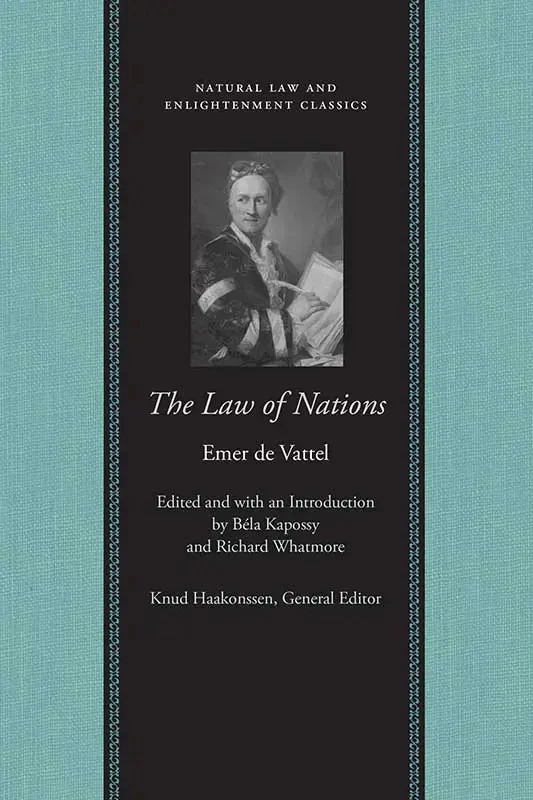
Law Of Nations, The
The great eighteenth-century theorist of international law Emer de Vattel (1714–1767) was a key figure in sustaining the practical and theoretical influence of natural jurisprudence through the Revolutionary and Napoleonic eras. Coming toward the end of the period when the discourse of natural law was dominant in European political theory, Vattel’s contribution is cited as a major source of contemporary wisdom on questions of international law in the American Revolution and even by opponents of revolution, such as Cardinal Consalvi, at the Congress of Vienna of 1815.
The significance of The Law of Nations resides in its distillation from natural law of an apt model for international conduct of state affairs that carried conviction in both the Old Regime and the new political order of 1789–1815.
The Liberty Fund edition is based on the anonymous English translation of 1797, which includes Vattel’s notes for the second French edition (posthumously published in 1773).
896 pages.
TABLE OF CONTENTS
IX
Introduction
XVI
A Note on the Text
XXV
Acknowledgements
1
The Law of Nations Or, Principles of the Law of Nature Applied to the Conduct and Affairs of Nations and Sovereigns
747
Essay on the Foundation of Natural Law and on the First Principle of the Obligation Men Find Themselves Under to Observe Laws
775
Dissertation on This Question: “Can Natural Law Bring Society to Perfection Without the Assistance of Political Laws?”
783
Dialogue Between the Prince of ****and His Confidant, on Certain Essential Elements of Public Administration
797
Biographical Sketches of Authors Referred to by Vattel
813
Bibliography
836
Index
Product Information
Product Information
Shipping & Returns
Shipping & Returns
Description
The great eighteenth-century theorist of international law Emer de Vattel (1714–1767) was a key figure in sustaining the practical and theoretical influence of natural jurisprudence through the Revolutionary and Napoleonic eras. Coming toward the end of the period when the discourse of natural law was dominant in European political theory, Vattel’s contribution is cited as a major source of contemporary wisdom on questions of international law in the American Revolution and even by opponents of revolution, such as Cardinal Consalvi, at the Congress of Vienna of 1815.
The significance of The Law of Nations resides in its distillation from natural law of an apt model for international conduct of state affairs that carried conviction in both the Old Regime and the new political order of 1789–1815.
The Liberty Fund edition is based on the anonymous English translation of 1797, which includes Vattel’s notes for the second French edition (posthumously published in 1773).
896 pages.
TABLE OF CONTENTS
IX
Introduction
XVI
A Note on the Text
XXV
Acknowledgements
1
The Law of Nations Or, Principles of the Law of Nature Applied to the Conduct and Affairs of Nations and Sovereigns
747
Essay on the Foundation of Natural Law and on the First Principle of the Obligation Men Find Themselves Under to Observe Laws
775
Dissertation on This Question: “Can Natural Law Bring Society to Perfection Without the Assistance of Political Laws?”
783
Dialogue Between the Prince of ****and His Confidant, on Certain Essential Elements of Public Administration
797
Biographical Sketches of Authors Referred to by Vattel
813
Bibliography
836
Index